Full Stack Development
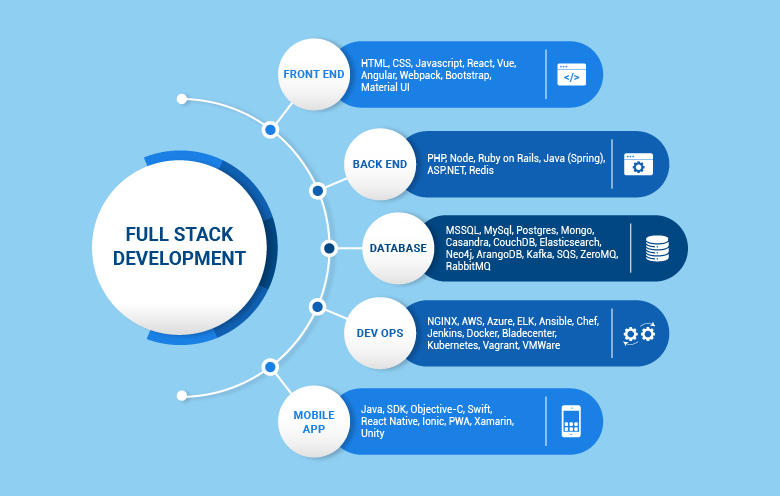
Full Stack Development refers to the comprehensive approach to web development that encompasses both the front-end (client-side) and back-end (server-side) aspects of an application. A full stack developer is proficient in multiple layers of the technology stack, allowing them to build complete web applications from start to finish.
Components of Full Stack Development
Front-End Development:
- The front end is what users interact with directly in their web browsers. It includes everything that users experience visually and interactively. Key technologies and concepts in front-end development include:
- HTML (HyperText Markup Language): The standard markup language for creating web pages.
- CSS (Cascading Style Sheets): A stylesheet language used to describe the presentation of a document written in HTML, including layout, colors, and fonts.
- JavaScript: A scripting language that enables dynamic content and interactive features on web pages.
- Frameworks/Libraries: Popular tools such as React, Angular, Vue.js, and Bootstrap help streamline front-end development by providing pre-built components and design patterns.
- The front end is what users interact with directly in their web browsers. It includes everything that users experience visually and interactively. Key technologies and concepts in front-end development include:
Back-End Development:
- The back end is the server-side of an application, responsible for processing requests, managing databases, and performing business logic. Key components include:
- Server: The software or hardware that responds to requests from clients, handling the application's logic and data processing.
- Database: A structured collection of data that the application uses to store and retrieve information. Common database technologies include MySQL, PostgreSQL, MongoDB, and SQLite.
- Server-Side Languages: Languages such as Node.js (JavaScript), Python, Ruby, PHP, and Java are used to develop the back-end logic and APIs.
- Frameworks: Back-end frameworks like Express.js (Node.js), Django (Python), and Ruby on Rails (Ruby) simplify the process of building server-side applications.
- The back end is the server-side of an application, responsible for processing requests, managing databases, and performing business logic. Key components include:
DevOps and Deployment:
- Full stack developers should also be familiar with deployment processes and tools to host applications. This includes:
- Version Control: Using systems like Git to manage code changes and collaborate with other developers.
- CI/CD: Continuous Integration and Continuous Deployment practices ensure that code changes are automatically tested and deployed.
- Cloud Services: Platforms such as AWS, Azure, and Google Cloud offer hosting and scalable infrastructure for web applications.
- Full stack developers should also be familiar with deployment processes and tools to host applications. This includes:
Technologies in Full Stack Development
- HTML, CSS, JavaScript: Core technologies for front-end development.
- React, Angular, Vue.js: Popular JavaScript frameworks for building user interfaces.
- Node.js, Express.js: JavaScript runtime and framework for server-side development.
- Python, Django: Server-side language and framework for web applications.
- Ruby on Rails: A web application framework written in Ruby.
- Databases: SQL (MySQL, PostgreSQL) and NoSQL (MongoDB) databases.
- APIs: RESTful and GraphQL APIs for communication between front-end and back-end.
- Docker: Containerization technology for packaging applications and dependencies.
Benefits of Full Stack Development
Versatility: Full stack developers can work on both front-end and back-end aspects, making them valuable assets in any development team.
Improved Collaboration: Being knowledgeable in both areas enables full stack developers to bridge communication gaps between front-end and back-end teams.
Cost-Effectiveness: Organizations can save costs by hiring fewer developers who can handle multiple aspects of development.
Faster Development: Full stack developers can streamline the development process, reducing the time taken to build applications by understanding the complete project scope.
Holistic Understanding: Full stack developers gain a comprehensive understanding of how various technologies interact, leading to better architectural decisions.
Challenges of Full Stack Development
Keeping Up with Technologies: The web development landscape is constantly evolving, and staying updated with the latest trends and technologies can be overwhelming.
Depth vs. Breadth: Full stack developers may have a broad skill set but might not have the depth of knowledge in specialized areas compared to front-end or back-end specialists.
Complex Problem Solving: Full stack developers often face complex problems that require knowledge across the entire stack, which can be challenging to resolve.
Time Management: Managing multiple aspects of development may lead to longer hours and increased workload, especially in tight deadlines.
Career Prospects in Full Stack Development
- Job Opportunities: There is a high demand for full stack developers across various industries, including technology, finance, healthcare, and e-commerce.
- Career Advancement: Full stack developers have the potential to advance into senior development roles, technical lead positions, or even managerial roles overseeing development teams.
- Freelancing and Entrepreneurship: With a wide skill set, full stack developers can work as freelancers, offering their services to clients or launching their own startups.
Conclusion
Full Stack Development is a dynamic and multifaceted field that combines front-end and back-end development skills. With the ability to build complete web applications, full stack developers play a critical role in modern software development. By mastering a diverse set of technologies and staying updated with industry trends, full stack developers can create innovative solutions that meet the needs of users and organizations alike.
working Full Stack Development Process
1. Planning & Requirement Gathering
- Objective: Understand the product goals, user needs, and technical requirements.
- Activities:
- Meet with stakeholders to define business objectives and user expectations.
- Gather functional and non-functional requirements (features, performance, security, etc.).
- Gather functional and non-functional requirements (features, performance, security, etc.).
- Define timelines, budgets, and resources.
- Outcome:
- A well-defined project scope with a development roadmap and timeline.
2. Design Phase
This phase focuses on the user experience and interface design.
- Activities:
- Wireframes: Create low-fidelity layouts focusing on functionality and structure.
- Prototypes: Develop interactive prototypes to simulate user interactions.
- UI/UX Design: Finalize high-fidelity designs, applying branding and aesthetics.
- Tools: Figma, Adobe XD, Sketch
- Outcome:
- Approved design mockups and prototypes ready for development.
3. Development Phase
The product is coded and developed in this phase.
- Activities:
- Frontend Development: Develop the user interface using HTML, CSS, JavaScript, React,Vue, etc.
- Backend Development: Build the server-side logic and APIs using frameworks (Laravel).
- Database Management: Set up and manage databases (MySQL).
- Version Control: Use Git for tracking changes and collaboration.
- Agile/Scrum Methodologies: Implement sprints to divide the project into manageable tasks.
- Outcome:
- Functional product with frontend, backend, and database integrations in place.
4. Testing & Quality Assurance (QA)
Testing ensures the product is free from bugs and meets the requirements.
- Activities:
- Unit Testing: Test individual components or functions.
- Integration Testing: Ensure that different modules work together smoothly.
- User Acceptance Testing (UAT): Test with end-users to validate functionality. (MySQL).
- Performance Testing: Check speed, scalability, and load handling.
- Outcome:
- Identified and resolved bugs, and the product is validated for launch.
5. Deployment
The product is released to a live environment where users can access it.
- Activities:
- Set up servers, domains, and cloud infrastructure (AWS, Azure, or DigitalOcean).
- Deploy the code to production environments.
- Run final tests on the production server to ensure everything works smoothly.
- Outcome:
- The product is live and accessible to users.
6. Maintenance & Support
After deployment, continuous monitoring and updates are needed.
- Activities:
- Bug Fixes: Monitor for issues reported by users or through logs.
- Updates & Enhancements: Add new features or improve existing functionality.
- Performance Monitoring: Ensure uptime, speed, and reliability.
- Technical Support: Assist users with any issues they face.
- Outcome:
- Product remains functional, updated, and aligned with evolving user needs.